Why does Bill Gates call AI more dangerous than nuclear weapons?
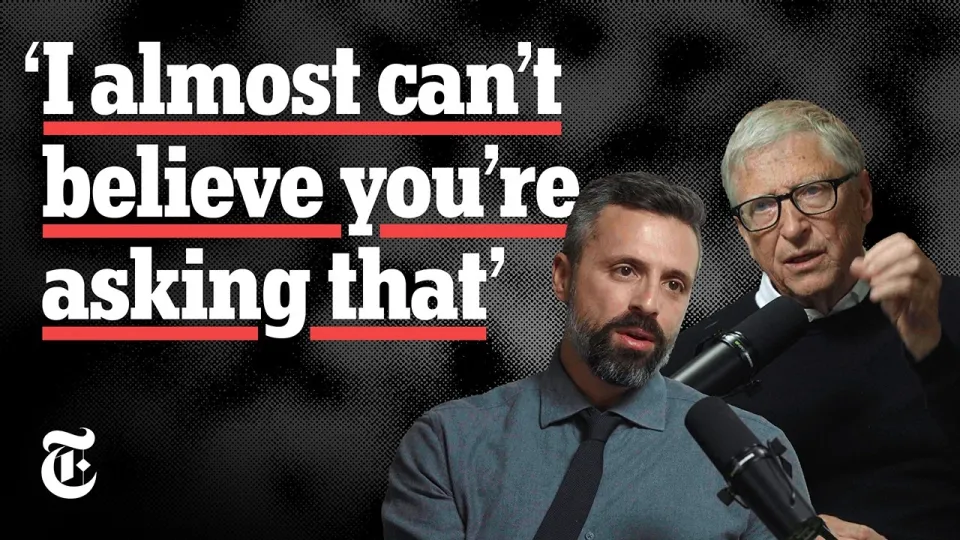
Video: Bill Gates: A.I. ‘Makes Nuclear Weapons Look Like Nothing’ | The Ezra Klein Show
Need articles like this for your video? They help promote it on YouTube and Google — order them in the Telegram bot @sat_sit_bot. Articles with your video embedded are written and posted by the bot itself — on popular topical sites (no ads). Your first 50 articles are free.
· based on the channel The Ezra Klein Show
Bill Gates argues that artificial intelligence is the most dangerous technology humanity has ever approached, and that its risks make nuclear weapons look minor by comparison. In his conversation with Ezra Klein, he says the danger is not speculative science fiction but a near-term policy problem: catastrophic cyberattacks, bioterrorism and mass job loss, arriving faster than governments are prepared to handle. The full interview and transcript are available at the New York Times page for the episode.
What does Bill Gates actually mean by comparing AI to nuclear weapons?
Gates is making a claim about scale and control, not about explosions. Nuclear weapons are built by a small number of states, require rare materials and leave a physical trail; AI is software that can be copied, fine-tuned and deployed by almost anyone with a laptop and an internet connection. That asymmetry is the core of his warning.
His argument runs through three points:
- Speed. AI capabilities are improving on a curve that outpaces the institutions meant to oversee them, so regulation written today may address a system that no longer exists next year.
- Access. The knowledge to cause harm — a cyber exploit, a recipe for a pathogen — is increasingly reachable through models that anyone can query, which lowers the barrier from "state program" to "individual actor."
- Denial. Gates is blunt that many people in positions of authority do not believe the risk is real, and that this disbelief is itself a danger.
He is not arguing that AI should be stopped. He is arguing that the gap between what the technology can do and what governments can govern is the actual threat.
Why Gates calls AI self-regulation "insane"
Gates rejects the idea that AI companies will police themselves, and his reasoning is economic rather than moral. Companies compete on capability and speed, so any firm that slows down to be safe hands advantage to a rival. Voluntary commitments therefore tend to be weakest exactly where the stakes are highest.
He is equally skeptical of liability as a backstop. In one of the sharpest exchanges of the interview, he dismisses the notion that a catastrophic harm could be addressed after the fact through a lawsuit — the scale of the damage makes courts an inadequate instrument. Regulation has to act before deployment, not after disaster.
This is where Gates diverges from figures such as Nvidia's Jensen Huang, who has argued that market incentives and reputational pressure will push companies toward safety. Gates's counter is historical: industries from tobacco to finance have shown that profit incentives do not reliably protect the public without rules enforced from outside.
The cyber and bio thresholds Gates wants governments to watch
Gates points to two specific areas where AI could cross from "risky tool" to "mass-casualty weapon." The first is cyber: models that can find and exploit software vulnerabilities faster than defenders can patch them, potentially disabling power grids, hospitals or financial systems. The second is bio: AI that lowers the expertise needed to design dangerous pathogens.
For each, the question is not whether the capability exists but whether the defense exists at the same speed. Gates's framing implies a threshold test for policymakers:
- Can an attack be carried out by a small group rather than a state?
- Can it cause harm at a scale courts and insurance cannot absorb?
- Does the defense require coordination that no single company can supply?
Where the answer to all three is yes, he argues, voluntary corporate policy is not a sufficient instrument.
The US–China race and why it complicates safety
Gates treats the AI competition between the United States and China as a structural obstacle to safety rules. If one country slows down, the other gains, so unilateral restraint looks like unilateral disadvantage. That dynamic is exactly what makes self-regulation fragile at the national level and nearly impossible internationally.
His position is not that competition should be abandoned but that some guardrails need to be agreed on before capabilities arrive, in the way nuclear arms control set rules even between adversaries. The political question — who negotiates, what is verifiable, what happens to countries that refuse — is where he thinks leadership is currently missing.
What AI does to jobs, and the case for taxing AI labor
On employment, Gates does not predict a single sudden collapse but a steady squeeze on entry-level and routine cognitive work. The policy conversation he wants is about what replaces wages as a source of income if AI meaningfully reduces the demand for human labor.
Among the ideas he raises:
- Taxing AI labor. If machine work substitutes for human work, the tax base built on payroll shifts, and something has to replace it.
- A no-scarcity job market. He describes a scenario in which AI drives down the cost of goods and services enough that scarcity itself changes shape — an optimistic case that depends on policy getting distribution right.
- "Human reserved" roles. Certain jobs, particularly in care and education, may be deliberately kept human for reasons of trust and social value rather than efficiency.
- Developing economies. Gates warns that gains could concentrate in rich countries, widening inequality unless the foundation and governments actively push access outward.
His foundation has made AI and inequality a new priority, alongside a plan to spend down roughly $200 billion over the next two decades.
AI in education and the rules children need
Gates is more optimistic about AI in classrooms than in most other domains, but he pairs that optimism with a warning about learning loss. Rich countries are already seeing students fall behind, and AI tutors can either close that gap or widen it depending on whether access is universal and whether the tools are designed to build skills rather than substitute for them.
He also calls for specific protections for children: age limits, restrictions on how AI systems engage minors, and rules on data and persuasive design. These are the kind of concrete, testable requirements he thinks regulators should start with, because they are politically achievable and do not require resolving every open question about frontier models at once.
Common questions about Gates's AI warnings
Viewers of the interview reacted with a mix of alarm and frustration, and several recurring doubts are worth addressing directly.
Is Gates exaggerating? He is a technologist who spent decades building the industry he is now warning about, and his tone in the interview is notably more agitated than in past appearances. That does not make his predictions correct, but it does mean the warning is not casual.
Why not just sue the companies? Because liability operates after harm, and the harms he describes — a crippling cyberattack, a pathogen release — are not the kind of damage a settlement repairs.
Does he want to slow AI down? No. He wants deployment to continue with rules in place, particularly around cyber, bio and children, and he treats the US–China race as a reason to negotiate early rather than a reason to wait.
What about the economic upside? Gates acknowledges large gains in medicine, education and productivity. His argument is that the upside is not automatic and depends on policy choices about access and distribution.
Useful links
- Full episode and transcript of Bill Gates on The Ezra Klein Show
- Book recommendations from guests of The Ezra Klein Show
The bottom line on AI risk
Gates's message is that AI is not a normal technology problem and should not be treated as one: the harms he fears most are fast, widely accessible and beyond the reach of courts or voluntary pledges. His prescription is unglamorous — regulation before deployment, international coordination despite competition, and specific protections for children — and he is openly frustrated that the people with authority to act do not share his sense of urgency. Whether or not his worst-case scenarios materialize, the interview makes a clear case that the policy debate is running behind the technology. The conversation, hosted by The Ezra Klein Show, is worth reading in full via the episode transcript before forming a view on what should be regulated first.
Key takeaways
- Gates calls AI the most dangerous technology humans have approached, saying it makes nuclear weapons look like nothing.
- He argues industry self-regulation is "insane" and that liability through lawsuits cannot handle catastrophic harm.
- Named thresholds: AI-enabled cyberattacks and bioterrorism, plus mass job displacement, are the risks he flags.
- The Gates Foundation plans to spend down roughly $200 billion over two decades, with AI and inequality as a new priority.
- He frames the US–China AI race and children's AI regulation as political questions, not technical ones.
Questions & answers
Why does Bill Gates say AI makes nuclear weapons look like nothing?
He is comparing accessibility and speed rather than destructive power. Nuclear weapons require rare materials and state programs, while AI is software that can be copied and used by small groups, and its capabilities are improving faster than regulators can respond. Gates argues that gap between capability and governance is the real danger.
Why does Gates think the AI industry cannot regulate itself?
Because companies compete on capability and speed, so any firm that slows down for safety cedes advantage to rivals. Gates also dismisses liability and lawsuits as a backstop, since catastrophic harms such as a major cyberattack or a pathogen release cannot be repaired after the fact by a settlement.
What risks does Gates single out as most urgent?
He focuses on AI-enabled cyberattacks that could disable critical infrastructure, bioterrorism enabled by models that lower the expertise needed to design pathogens, and mass job displacement. For children, he calls for age limits and rules on data and persuasive design as concrete first steps.
Does Gates want to pause AI development?
No. He wants deployment to continue with guardrails in place, particularly around cyber, bio and minors. He treats the US–China competition as a reason to negotiate rules early rather than as a reason to wait, since unilateral restraint looks like unilateral disadvantage.
Source: Bill Gates: A.I. ‘Makes Nuclear Weapons Look Like Nothing’ | The Ezra Klein Show · Markdown version